Hailsham gallery collection
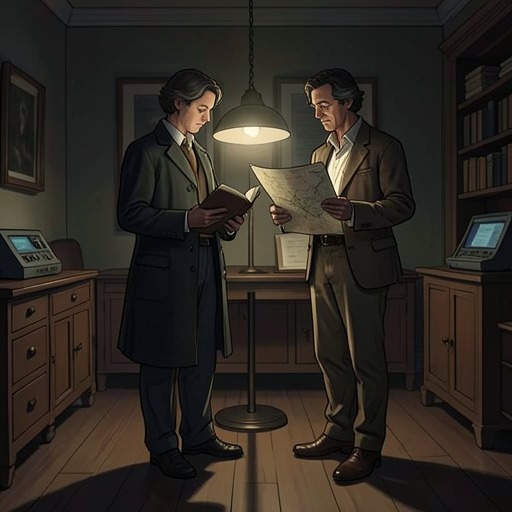
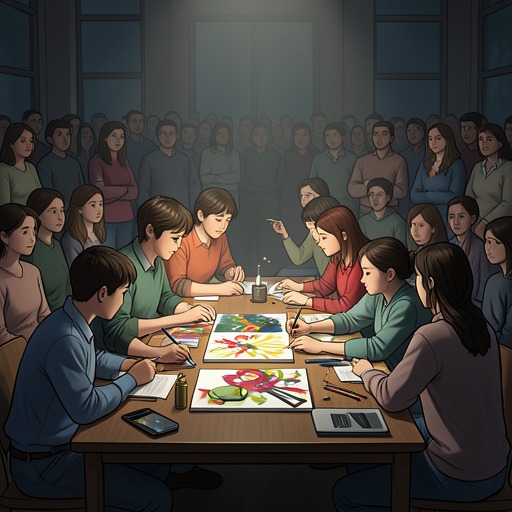
Never Let Me GoThe Hailsham gallery collection was made up of paintings, poems, and other work gathered from Hailsham students over many years. Its purpose becomes a point of dispute when Tommy and Kathy visit Madame seeking a deferral: Tommy believes the collection was intended to help distinguish couples who were genuinely in love. Miss Emily’s account replaces that private theory with a political history. The work had been collected and publicly exhibited to challenge the assumption that students were less than human, and to make their inner lives visible to the world.
The Collection and Its Students
Madame describes the collection as the students’ paintings, poems, and other creations that she gathered over the years. The effort was substantial, she says, and she and her collaborators believed in it. Students themselves called it the Gallery, a name that Madame remembers initially finding amusing but eventually adopted. The shift from her collection to their Gallery gives the work a shared identity: it belonged to the institution that selected and preserved it, but also to the students whose efforts filled it.
The collection was selective rather than an undifferentiated archive. Miss Emily later confirms that the adults chose the best work and put it into special exhibitions. In the present, part of the collection is kept in Madame’s house; she says it had to be reduced because there was not room for everything. Its physical survival is therefore incomplete. The works remain, but the collection has been pruned, and the account gives no inventory of what was retained or lost.
Tommy’s Theory of the Gallery
Tommy brings the Gallery into the conversation as an explanation for the deferral he and Kathy hope to receive. His reasoning is that the artwork gave Madame something to assess: without it, he suggests, she would have no basis for deciding whether students who claimed to be in love truly were. In this theory, art acts as evidence of an inward state, and the collection becomes part of a process for judging the sincerity of a couple.
Madame asks why Tommy thinks the collection could show who was genuinely in love. Her question leaves room for him to explain, but it does not confirm his conclusion. When Tommy later asks whether the Gallery existed at all, Miss Emily answers that there was a Gallery, and that in a reduced form it still exists. That confirmation is narrower than Tommy’s theory: the collection was real, but Miss Emily’s explanation identifies a different purpose for gathering the work. The distinction matters because the students have built a possible route to postponement from the evidence of an institution whose actual goal was not to grant one.
Miss Emily’s Explanation
Miss Emily says Hailsham collected the students’ artwork because its leaders believed the work could reveal their souls—or, more precisely, prove that they had souls at all. She accepts the central part of Tommy’s thought that art disclosed something about what the students were like inside, but corrects what he believes the collection was meant to do. Its intended audience was not a couple seeking a deferral; its intended function was to make the students’ humanity legible to other people.
This explanation also recasts the students’ education. Kathy asks why they were trained and encouraged to produce art, and why they had lessons, books, and discussions if they were still destined to make donations and die. Miss Emily links that cultivated education to the belief that students raised in humane surroundings could become as sensitive and intelligent as ordinary people. The collection was thus not merely a record of individual talent. It was presented as proof in an argument over how the students should be regarded.
Exhibitions and the Hailsham Campaign
Miss Emily places the Gallery within a broader movement that included Hailsham, Glenmorgan House, and later the Saunders Trust. Together, she says, they formed a small but vocal campaign challenging the way the Donation Programme was run. Their work opposed a society in which clones had previously been treated chiefly as sources for medical science—shadowy objects in test tubes, in her account—rather than as people capable of thought and feeling.
At the height of the movement’s influence in the late 1970s, its members organized large events around the country. Cabinet ministers, bishops, and other prominent people attended; speeches were made and substantial funds pledged. The selected artwork gave the campaign something concrete to show. By presenting the work as the achievement of students, the organizers could argue that the people who made it were fully human. The collection therefore moved from Hailsham’s internal life into public persuasion: works produced by students became evidence in a national argument about their treatment.
Meaning and Limits
The collection’s significance rests partly in the gap between what the students infer from it and what its advocates intended. Tommy sees a possible key to a personal reprieve; Miss Emily recalls a campaign for recognition that could not secure that reprieve. She stresses that the movement did improve the students’ circumstances by giving them humane surroundings and protecting them from some of the worst horrors, but that it could never grant the deferral they hoped for. The Gallery’s persuasive power and its limits belong together: it could help demonstrate the students’ humanity without overturning the system that still required their donations.
That history also lends the collection an uneasy double character. It preserves the students’ work and gives it public consequence, yet the work was gathered because outsiders demanded proof of something the students’ lives already embodied. What Tommy takes as a possible instrument of rescue was, in Miss Emily’s account, an instrument of advocacy. The surviving collection in Madame’s house stands as the reduced material remainder of that effort, while its original public purpose survives in the explanation of why Hailsham gathered and exhibited the students’ creations.